Moving to Florida is a dream but landscaping in Florida can be a learning curve. At Renovation Outdoors, we've spent more than a decade working on properties across Lake County and greater Central Florida, including Clermont, Groveland, Minneola, and Winter Garden, and we see the same mistakes over and over. Most come from applying northern-landscaping logic to a subtropical climate, or from a visually appealing idea that simply doesn't withstand 95°F summers and 40 inches of rainy-season rainfall.
Here are the eight most common Florida landscaping mistakes, and exactly how to avoid them.
1. Ignoring Drainage Before Installing Florida Landscaping
This is the most common mistake we encounter. New homeowners plant beautiful flower beds, pour a patio, or install sod, and then realize in July that half their yard is under water every afternoon. Florida's flat topography and sandy-over-clay soil mean water often doesn't go where gravity suggests it should.
Avoid it: Walk your property after a heavy rain before you install anything. Any spot that holds water more than an hour needs drainage (grading, a French drain, or a catch basin) before softscape goes in. Our irrigation & drainage team will be happy to assist with this, and you can reach out for a quote at no charge.
2. Choosing the Wrong Grass for Florida Yards
Not every lawn in Florida should be Floratam St. Augustine. Heavy shade? Floratam will thin out. Constant full sun and sandy soil? Bahia or Zoysia may be a better fit. Pets and heavy traffic? Zoysia handles wear better than most.
Avoid it: Match the sod to the site (sun exposure, traffic, irrigation, and budget), not to what the neighbor has. A quick site visit from our sod team can prevent a costly failed installation.
3. Planting Non-Native Species That Can't Survive Florida Heat
Florida garden centers sell things that don't actually thrive here. Boxwood, hydrangea, hosta, and lilacs: you'll find them on shelves, and you'll lose most of them within two summers. Heat, humidity, nematodes, and salt air conspire against plants that evolved in cooler, drier climates.
Avoid it: Lean heavily on Florida-friendly or Florida-native species: viburnum, firebush, Simpson's stopper, coontie, saw palmetto, beautyberry, muhly grass, society garlic, and dwarf yaupon holly. The UF/IFAS Florida-Friendly Landscaping program is a great reference.
4. Overwatering Your Florida Lawn in the Rainy Season
Irrigation is a two-edged sword in Central Florida. Homeowners set their sprinkler timers in March, forget about them, and keep watering every day through July when the sky is already delivering an inch a day. The result is root rot, fungal disease, and an inflated water bill.
Avoid it: Install a rain sensor (required by Florida statute for new systems) and a smart controller that pulls weather data. Run irrigation twice a week max during the rainy season. Better yet, audit your system every spring.
5. Piling Mulch Too Deep Around Florida Plants
"Mulch volcanoes" piled 6 to 8 inches deep around tree trunks and plant stems look tidy at first and then cause slow-motion damage: rot, pest habitat, and roots that grow up into the mulch instead of down into the soil.
Avoid it: 2 to 3 inches of mulch, pulled back 2 to 3 inches from stems and trunks. Refresh once or twice a year, not five inches at a time. Cypress, pine bark, or melaleuca all hold up well in Florida rain.
6. Skipping Clean Edges and Bed Lines
A landscape looks instantly cheaper when bed lines are wavy, mulch spills onto sod, and grass creeps into flowerbeds. The line between lawn and bed is doing 50% of the work on how polished a yard looks.
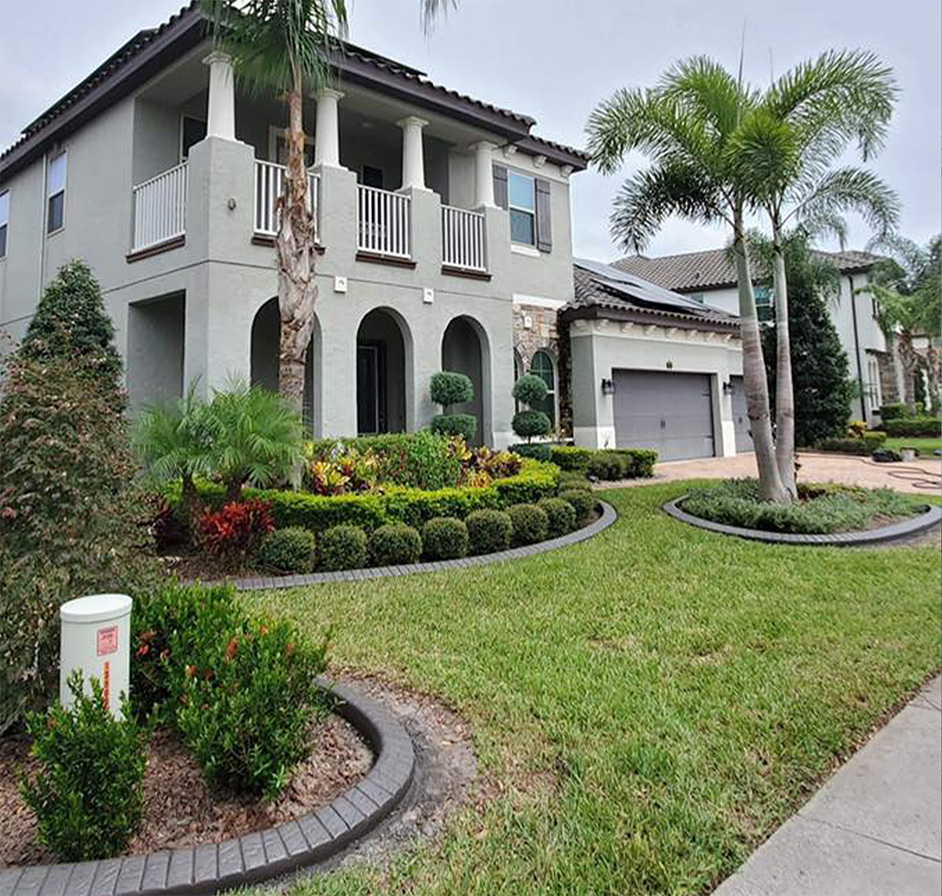
Avoid it: Install a clean edge: a spaded trench, metal edging, or custom concrete landscape curbing. Curbing is the single highest-ROI upgrade for curb appeal in Central Florida; it doesn't move, doesn't rot, and keeps mulch where you put it.
7. Treating Outdoor Lighting as an Afterthought
Florida has the most beautiful evenings in the country, and most yards go completely dark at 8 PM. No lighting means no curb appeal after sunset, no usable outdoor living, and real safety risks on dark walkways and pool decks.
Avoid it: Plan landscape and path lighting during the design phase, not after. Even a modest LED system on pathways, uplights on a few signature trees, and a wash on the façade makes a dramatic difference. Group it into zones so you can control what's on.
8. Treating Florida Landscaping as a One-Time Project
The biggest mental mistake is thinking a yard is ever "done." Florida landscapes evolve faster than almost anywhere in the country: plants mature in 18 to 24 months, mulch breaks down every 6 to 9 months, irrigation zones drift as soil shifts, sod renews itself seasonally, and sun exposure changes as nearby trees grow. A landscape you install and ignore is a landscape that quietly degrades, often without you noticing until the cost to fix it has climbed.
There is also a meaningful difference between the cost of routine maintenance and the cost of reactive repair. A modest seasonal investment in pruning, mulch refresh, and irrigation tune-ups consistently prevents the kind of issues that become significant repairs: dead sod, failed hedges, clogged drains, or a blown sprinkler valve that floods a bed. Most of our maintenance clients in Clermont, Groveland, and Winter Garden describe the predictable monthly or seasonal investment as the most economical part of caring for their landscape, and the part that protects every other investment they've made in the property.
Avoid it: Budget for seasonal touch-ups and put them on a calendar before the season arrives. A healthy Florida maintenance cycle typically includes a spring cleanup and fertilization, summer pruning and pest monitoring, a fall mulch refresh and irrigation audit, and a light winter tune-up for cold-sensitive plants. Professional ongoing care usually covers trimming, bed re-edging, weed control, fertilization timed to Florida's climate, irrigation inspections, lighting checks, and seasonal color swaps. Our landscaping enhancement service is built exactly for this, so you never have to wonder what needs doing next or why something suddenly looks off.
Common Questions About Landscaping
What are the most common landscaping mistakes in Florida?
The biggest issues we see are: poor drainage, planting non-Florida-friendly species, overwatering during the rainy season, choosing the wrong grass for the exposure, piling mulch too deep, neglecting clean bed edges, skipping landscape lighting, and treating the yard as a one-time install. Addressing even a few of these transforms a property.
Why does my Florida lawn keep dying?
Usually one of three culprits: a sprinkler zone that isn't covering evenly, chinch bug or fungal pressure that hasn't been treated, or sod that was wrong for the site (too much shade for Floratam, or too little water for a new install). A quick irrigation check plus a simple pest and disease diagnosis usually reveals the cause in under an hour.
Do I really need a professional landscaper in Central Florida?
For mowing and basic upkeep, not necessarily. But for drainage, irrigation, sod installation, hardscape, and overall design, a local pro pays for themselves. Small mistakes get expensive fast.
Avoid the missteps. Get it right the first time. Renovation Outdoors helps Central Florida homeowners get it right the first time, from drainage to design to done-for-you maintenance. Call 407-743-8043 or request a free quote by talking with our team about your property.


.png)